
How To Evaluate Your Top Competitors For Music Lessons
In my article, How To Use Keywords To Start Your Home Business As A Music Teacher, I show you how to find your top ten competitors in local search. Now, we’ll analyze those ten businesses and get some important insights. We have three objectives:
- 1Find out what your competitors charge to help you set your own price.
- 2Map their locations to see how close you are.
- 3Evaluate their online strategies so you will know how to compete in local search.
Here is a Competitor Comparison Spreadsheet you can use to track your progress. The three steps correspond to the three tabs in the spreadsheet for you to fill out.
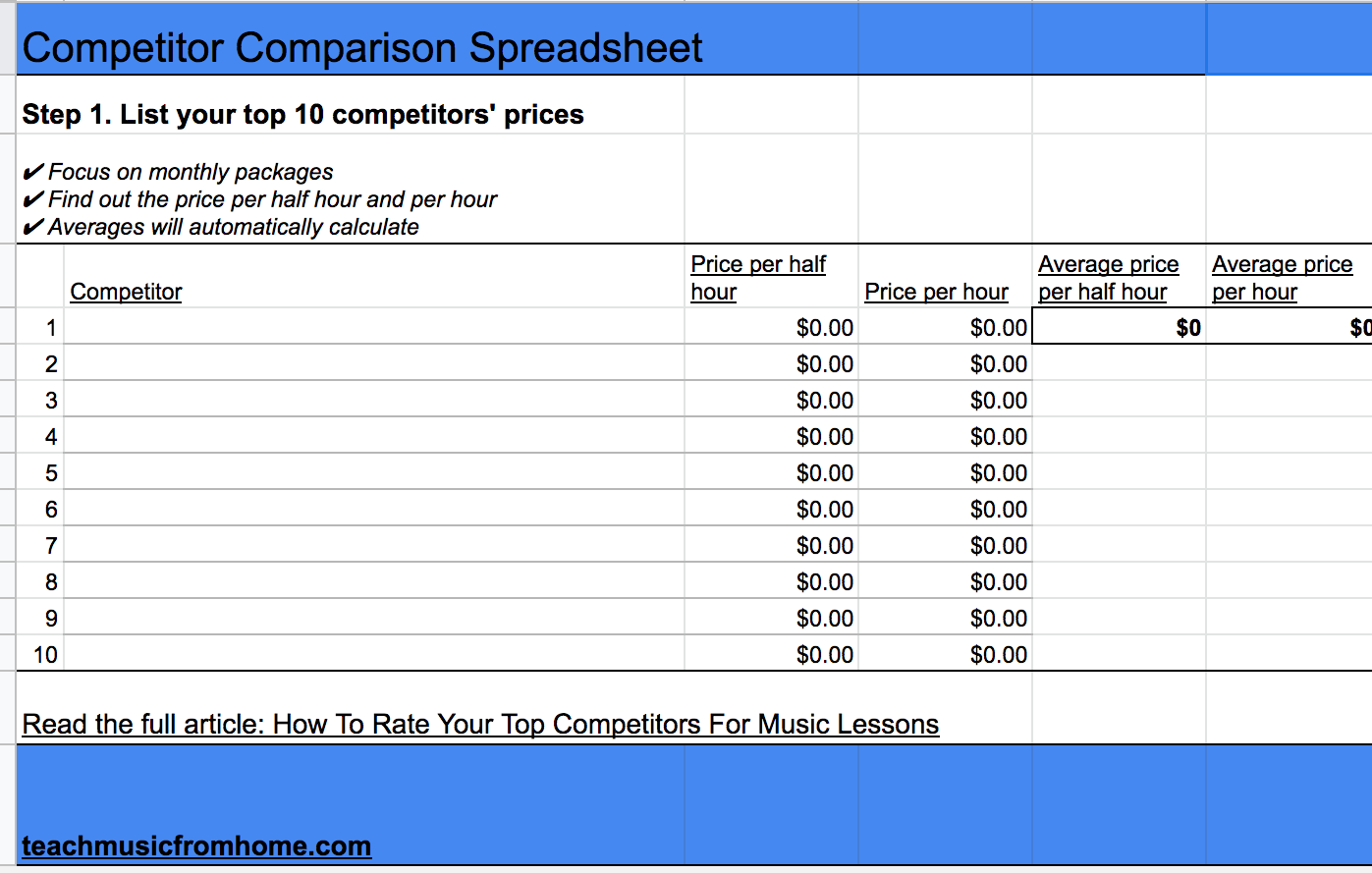
Step 1. List your top 10 competitors' prices.
Start by listing your competitors’ prices. If you can’t find out on their website, call and ask.
Monthly billing
When you research your competitors’ prices, the monthly price is the best one to track. Monthly billing is effective. That’s the only billing model I recommend for music teachers. Divide the monthly price by four to find the price per session.
Price per half hour
30 minute lessons are usually the shortest session length music teachers provide. These are easier to sell than hour sessions because they are cheaper and more convenient. How much does each of your top ten competitors charge for a half hour lesson?
Some competitors only offer hour lessons. Take their hourly price and divide it in half to get an estimate of what they might charge if they did offer 30 minute lessons.
Price per hour
60 minutes is usually the longest session length that students will take. These are a great up-sell for half-hour customers. Hour sessions are ideal for serious students. How much do your competitors charge per hour?
Average price
Now that you have your price list, you know what the average price is in your area per half hour and per hour. This will be important to know when you build your business model and set your own price. You’ll be able to set yourself at an above-average price based on your extra valuable teaching.
Step 2. List your top 10 competitors' locations.
Exactly where are your competitors are operating? When you’re marketing your business, you should know what type of facilities your competition are using and where they are located. This could lead to insights on how you can highlight your own position.
Type
What type of studio is each of your competitors using to teach lessons? You’re probably competing with diverse business models. Most of your local music lesson competitors can likely be categorized as:
- Music schools
- Music stores
- Home-based music teachers
- Mobile music teachers
Music schools tend to be the most challenging competition. They have many students and a high budget so they can hire some of the best teachers in town. They can also compete with low prices. But they can have trouble managing so many students.
Many customers are not looking for that kind of studio. Instead they want a premium music teacher who is also the business owner. A single teacher with a short list of students can charge more than a school. That’s because of your limited availability and your greater attention to every student and customer account. And a clean home studio offers a more intimate experience than tiny practice rooms in a strip mall.
Cross streets
What is the exact location of each of your customers? Look up their cross streets and list them. If they are several miles away from you, you’ll have a neighborhood advantage. If some of them are in your own neighborhood they’ll be your most direct competition.
Region
What part of your town or city are each of your competitors in? You can categorize them with descriptors like northeast, or with suburb names. Location convenience will impact each of your competitors in different ways and determine their ideal customers.
Try to identify an advantage that your home has compared to other studios, such as freeway access or proximity to a high income township. If you find one, it will be a powerful key in your marketing strategy.
Step 3. Evaluate your top 10 competitors' online strategies.
Now that you know where your competitors are and what they’re charging, you can see what kind of strategies they’re using online. Their search rankings are the reason why they are your top competitors. How are they doing that?
If you’re in a highly competitive place, they’re doing it through skillful online strategies. You can examine them and find weaknesses or ways around them. You might be able to outperform them. Or, you might be able to find a narrower niche where they have less authority.
If you’re in a less competitive place, they might not be skillful at all. It might simply be because the search engine can’t find anything better. If that’s the case your startup strategies will be simple.
Here is a set of 16 benchmarks you can review for each of your competitors. This will give you a good idea of how skillfully they are approaching local search.
Reviews
How many Google reviews do your competitors have? This is a great way to get your business to pop in Google’s local map pack above the search results. It’s also a factor in your website’s ranking. And it’s a great customer selling point if you have a lot of good reviews.
Star Rating
What is each of your competitors’ average star rating for Google reviews? A music school or a music teacher with an average in the 4-5 range is a strong competitor.
GMB
Are you able to find a Google My Business (GMB) profile for each of your competitors? That’s the listing that shows up in Google Maps. If not, they are missing out on an important and easy step in their marketing.
Strong SEO
Which of your competitors have the top 3 rankings for your 3 target keywords? Unless you see contradictory signs, they are probably using good search engine optimization (SEO) strategies on their site. These competitors who are already actively optimizing for the same keywords as you will be the hardest to overtake in the search rankings.
Phone number
When a potential local customer is on your home page, they need to be able to find a phone number. If a competitor’s phone number isn’t easy to find and easy to read at the top of their home page, they’re at a disadvantage.
Pricing
Most customers who are comparing websites don’t like having to call for information. Your complete pricing information should be easy to find. If a competitor is hiding their price, they’re at a disadvantage. They are forcing customers to call and haggle. A skillful competitor will make their prices obvious.
Address
Are your competitors making their address easy to find? Like the phone number, this is an easy piece of information that customers are looking for. The businesses that include it have another advantage. It's used by search engines as a signature to give your business legitimacy. That’s a huge factor for your rankings.
Offer
Do your competitors explain exactly what they offer? Who do they serve? What instruments and what ages do they teach? Do they include people with special needs? You should be able to answer these questions with a quick scan. Many music teachers and music school owners don't know how to make their offer clear. A skillful competitor will make their offer very clear and easy to find.
Social proof
Do your competitors’ sites include customer testimonials? Quotes from happy customers are a great way to build your reputation. Once you have a nice testimonial, you’ve got it for life. If your competitors aren’t using this kind of social proof, they are leaving money on the table.
Teachers
Do your competitors provide personal details about their instructors? Potential customers will read their site looking for background information on their future teacher. This is a great way to build rapport without any work other than writing a bio.
Methods
Do your competitors’ websites include details about their teaching methods? Most will not. But it’s a common question that parents and students have. If you can find out about a competitor’s teaching methods from a quick scan, they have an advantage.
Sales copy
How convincingly do your competitors pitch their service? Do their websites present compelling selling points? Do they say what makes them unique? Do they boast anything with real value? If they don’t, they are not strong online marketers.
Editing
Is the text on your competitors’ sites easy to read and engaging? If customers have a hard time reading the text on the site, they are going to browse to another site. If you were a customer, would you have an urge to stop reading the site or to continue? This speaks to your competitor’s writing skill.
Content
Websites with deep text content tend to rank better than sites with thin content. Do your competitors’ sites have pages with more than 2000 words? If so, this indicates that they are following the best practice to rank their website in search engines.
Design
Are your competitors’ websites easy to use and attractive? You should be able to find everything you’re looking for without much effort. If you find anything about their sites confusing, customers probably will too. A skilled competitor’s site will be easy to use. The fonts and headings will be easy to read. It will have quality photos. It will also use attractive colors in a way that helps you read and navigate.
Mobile
The last benchmark is one of the most important. More shopping is taking place every day on mobile devices. Are your competitors’ sites easy to use on a mobile device? Google has started categorizing sites as “mobile-first” if they follow mobile-friendly guidelines. Google will give those sites an advantage in local search. Are your competitors working to take advantage of mobile-first design?
The Competitor Comparison Spreadsheet gives you a page to check off these benchmarks for each of your competitors. Once you’ve completed that, you can see at a glance who is actively trying to win online in your space. Your top ranking competitors will probably be the ones checking off the most benchmarks.
In the next article, How To Select A Profitable Niche As A Music Teacher, we’ll look at where you can best fit into the competition. By offering something unique or even slightly different, you can cut through the search rankings with your new business.