
How To Select A Profitable Niche As A Music Teacher
If you’re starting a business as a music teacher you have to choose exactly what you’re going to provide.
If you try to market yourself as the best teacher for everyone, you’ll be at a disadvantage. Any competitor with a more specific niche will have a more expert position for that subject. You’ll be taking on every teacher in town.
The best strategy for starting a business is to focus your efforts around a narrow market. Be one of those experts in a subject that makes generalist teachers seem inadequate for the job. Find a valuable niche, and focus on getting to the top of it.
Keyword research will get you started in understanding the niches that your competitors are going for. It might even give you all the information you need to choose a great niche for yourself. But its more likely you need to get creative to think of niches with lower competition.
When you brainstorm niches to target, you need to know how challenging the competition is. Then you’ll be able to choose from less competitive spaces. You might even think of a valuable market no one else is serving. That is what happened for me, and it was one of my keys to success as an entrepreneur.
We’ll break the process of selecting a niche into three steps:
- Research your competitors' niche offerings.
- Sort the niches in your area by their availability.
- Find a valuable niche.
Step 1. Research your competitors' niche offerings
Start by finding your main competitors. I have a process for that here: How To Use Keywords To Start Your Home Business As A Music Teacher. Next we’ll find out what specific niches those businesses are serving.
Music teacher niches
Anything that describes your service more than simply “music lessons” is a niche. There are several typical niche offerings that you might find in your area. Here are some of them:
- Instrument niches
- Age niches
- Proficiency niches
- Genre niches
- Special needs
Special education is one of the niches that made my business successful. I couldn’t believe it when I saw no one in my town advertising special needs music lessons.
Let’s take a look at what niches the businesses in your area currently offer. We’ll use your top 10 competitors’ websites as a basis for this research. Here is a spreadsheet that will help you track your findings. It also ranks those niches by their availability: Niche Competition Spreadsheet.
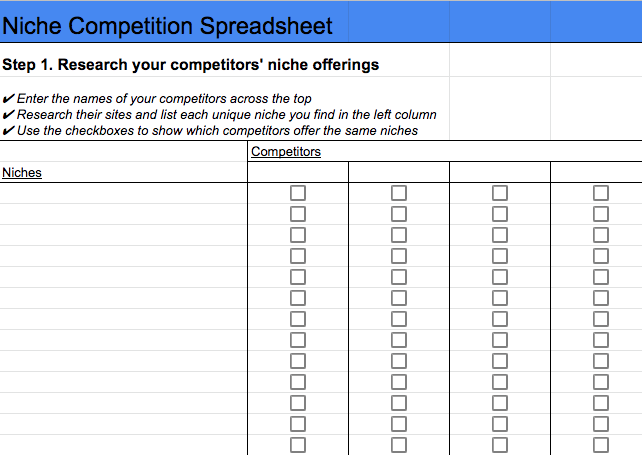
❑ Take Action: Enter the names of your top ten competitors across the top of the spreadsheet. Browse through each of their websites. In the left column, list each unique niche they mention on their sites. Use the checkboxes to show which niches each company serves. You should see many companies offering some of the same niches.
For example, if a competitor called ABC Music Co. has group classes for toddlers, enter “group classes for toddlers” in the left column. Check the box under ABC Music Co. in that row. If another company also has group classes for toddlers, check the box under that company also. Now the “group classes for toddlers” niche has 2 check marks.
This research will give you an idea of what is and isn’t currently available in your area. It will illustrate how competitive each niche is in your area.
Step 2. Sort the niches in your area by their availability
How many companies are already offering a particular niche? What does that availability say about how competitive the niche is and how difficult it will be to enter it?
Availability of a niche in your market shows that there is competition, but also that there is demand.
Navigate to the second tab in the spreadsheet, called “Niche Availability.” Sort this sheet by Column B (click the dropdown for Column B and select Sort Sheet Z–A). This will order the niches by their availability in the market. The niches that the fewest competitors provide are at the bottom of the list.
Step 3. Find a valuable niche
We’ll focus on three criteria to narrow down your search:
- Low competition
- Alignment with your skills
- Market demand
Low competition
Some niches are more in demand than others, and can support more competitors. For example, most towns can support several drum teachers. But they may only have enough demand to support one or two oboe teachers.
The availability of services is only a hint of the competitiveness of the niche. It can give you a sense of what is available. In situations with many competitors, there may be room for one better. You’ll need to analyze the competitors to know how hard it will be to compete with them. Here I share my strategy for doing that: How To Rate Your Top Competitors For Music Lessons.
If your first instinct for a niche seems too competitive, you should expand your search.
❑ Take Action: Choose your most obvious and likely niche. How available is that service in your area? How strong is the competition? This should give you a sense of whether you need to look for a different niche to help you stand out.
Alignment with your skills
Music teachers who become the best in town for a niche have the skills to back it up. And the fact that you’re a musician means you’ve got those. You can only teach what you know. Your niche will have to align with those skills. But most musicians are experts at more than their instrument.
Depending on what subjects you can teach, you can narrow or broaden your focus. For example, if you play 10 instruments you should start by marketing only your best ones. If you only play one instrument and it’s too competitive in your area, target related niches. For example you might be good at music theory or production. You might be able to create musical experiences for toddlers. You might have a skill for working with people with special needs.
❑ Take Action: Brainstorm ideas for outlying niches that align with your skills. Look for ideas that have less competition in your market.
Market demand
Now you may have found some interesting niches. Of course, they’re only relevant if there’s a real demand in the market for them. Before launching an offering, try to make sure that there are people in your community who will buy it.
Again, one indicator of market demand for a service is the availability of the service in the market. If your niche has a lot of competitors but few of them appear to be strong at local search marketing, great. That’s all the evidence you need. It’s time to go for it.
But the best situation is where you find a service that people are eager to buy, and few or no other teachers offer it. You’ll be the best almost overnight.
In many places, special education is that opportunity. Most places are so far behind it's sad. They aren't serving the market of parents and students with disabilities. These people are asking for music lessons. They want teachers. They are patient and encouraging to new teachers and businesses. This is a community you want to join.
Early childhood education is another. There are always new little kids coming on the scene and their parents demand music. They are new to the industry and willing to try new businesses.
In the next article we’ll take a closer look at the demand for your niche. This will complete the research process. You can read it here: Assessing Your Market As A Self-Employed Music Teacher (COMING SOON).